Ai Weiwei
The Cultural Cartographer And Interrogator Of Conscience
By Afef Yousfi
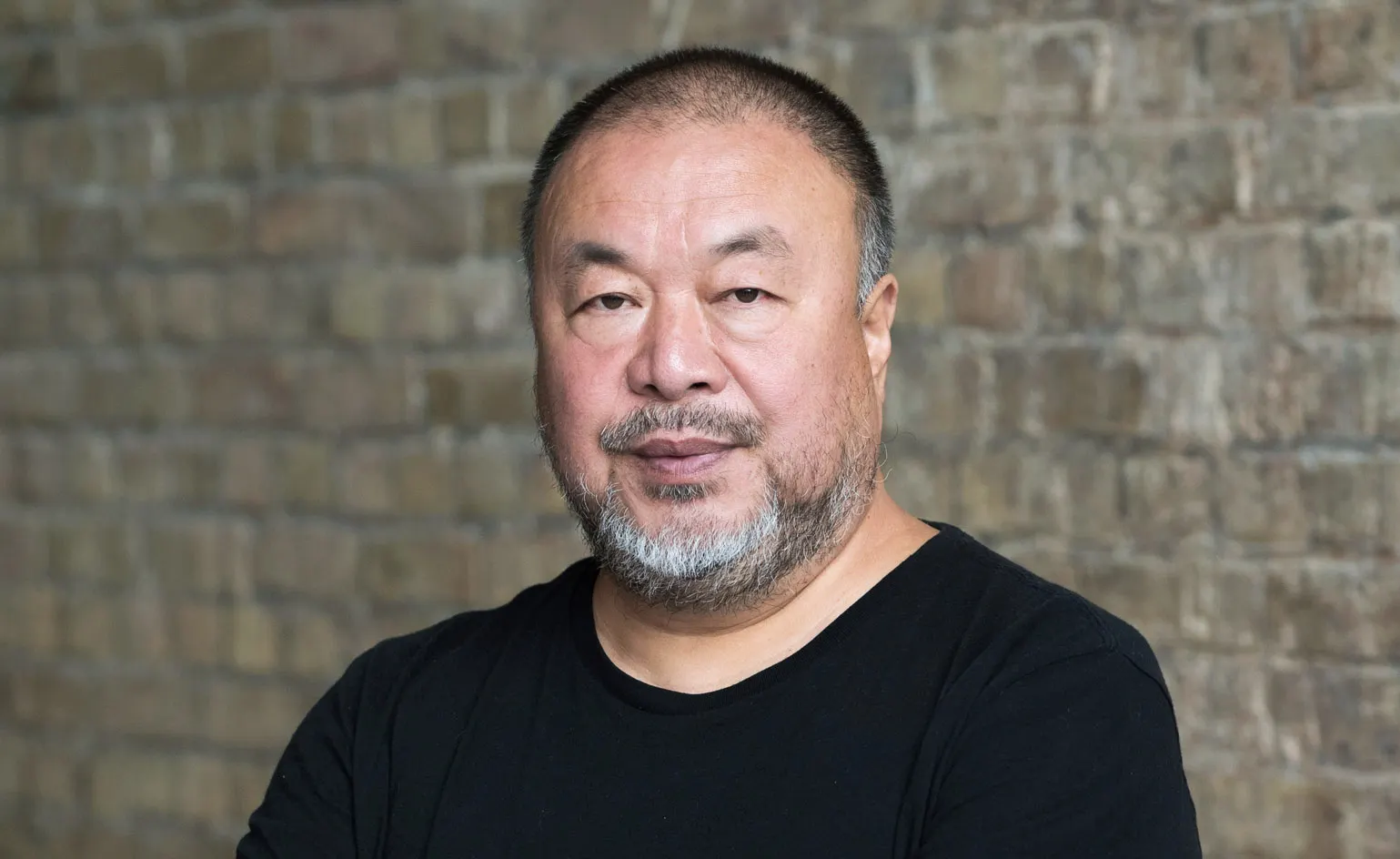
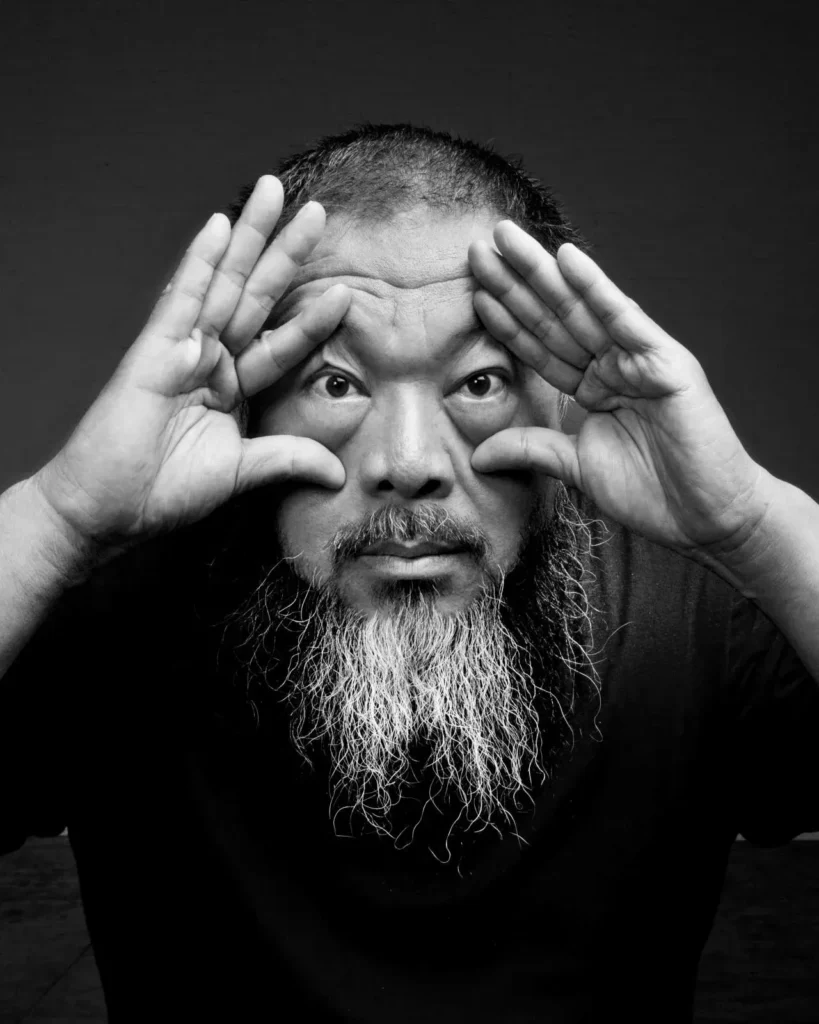
Ai Weiwei is not merely an artist, he is a chronicler of conscience, a relentless interrogator of power, and a cultural cartographer whose work traces the fractured line between individual liberty and state control. His life, a turbulent odyssey mirroring the political vicissitudes of his homeland, has served as the foundational substance for a body of work that defies easy categorisation, flowing seamlessly between conceptual art, architecture, social commentary, and unvarnished activism. To grasp his creative lexicon is to understand the legacy of a man for whom expression is an imperative, not an option.
Born in 1957, his early existence was irrevocably shaped by the fortunes and misfortunes of his father, the esteemed poet Ai Qing, who was denounced as a “rightist” during the Anti-Rightist Movement. This political designation sentenced the family to years of internal exile in remote, unforgiving regions, first to Heilongjiang and then to the deserts of Xinjiang. This profound exposure to the periphery, to the state’s capacity for erasure and displacement, instilled in the young Ai a deep-seated scepticism towards official narratives and a tenacious empathy for the marginalised. He grew up on the wrong side of the revolutionary ideal, learning early that the line between hero and pariah was drawn not by truth, but by political diktat.
The 1980s saw him gravitate to the crucible of the New York art scene, a period of transformative exposure to Western avant-garde thought, particularly the audacious irreverence of Marcel Duchamp and the pop-art ubiquity of Andy Warhol. Here, Ai did not merely consume, he absorbed new methodologies, particularly the use of the ‘readymade’ object, which he would later weaponise for cultural critique. This experience equipped him with a vocabulary to articulate the complexities of Chinese identity upon his return to Beijing in 1993, driven by his father’s failing health.
His immediate post-return work was a series of provocative acts of cultural iconoclasm that sought to redefine the value and veneration of Chinese historical artifacts. The infamous triptych Dropping a Han Dynasty Urn (1995) captures him wilfully shattering a two-thousand-year-old ceremonial vessel. This was not vandalism, it was a conceptual thunderbolt. It questioned the unquestionability of history and the state’s monopolistic control over cultural heritage, implicitly asking whether a historical object’s value lies in its age, its intrinsic beauty, or the market/political power invested in it. Similarly, works like Han Dynasty Urn with Coca-Cola Logo (1994), where he emblazoned a Neolithic vase with the instantly recognisable global corporate emblem, created a seismic collision between ancient sanctity and modern, homogenising consumerism. He used the past as a raw, pliable material, not a sacred relic, a gesture that was both a continuation of Duchamp’s lineage and a distinctly Chinese critique of a culture that simultaneously venerated and neglected its own history.
Ai’s artistic practice began to fuse irrevocably with his political and social conscience, morphing into a form of archival dissent. A pivotal moment was the 2008 Sichuan earthquake. The subsequent cover-up and lack of transparency regarding the thousands of schoolchildren who perished due to poorly constructed, corruptly signed-off ‘tofu-dreg’ schools ignited a fury in him that he channelled into an unprecedented act of investigative journalism and art. He launched the Sichuan Earthquake Names Project, using his burgeoning online presence, a blog, then Twitter, to mobilise a network of volunteers to compile the names of the dead children, a list the government had intentionally suppressed. This was art as data retrieval, as collective memory fabrication.
The resulting artworks were devastatingly poignant. Remembering (2009) installed a monumental text on the façade of the Haus der Kunst in Munich, crafted from thousands of coloured backpacks that spelled out a quote from one of the victims’ mothers, “She lived happily on this earth for seven years.” The work transformed a personal tragedy into a colossal public testimonial. Straight (2008–2012) was an even more visceral response. Working with local artisans, he painstakingly retrieved and hand-straightened the mangled steel rebar from the collapsed schools, eventually compiling 38 tonnes of it into a vast, floor-based sculpture. The sheer magnitude of the work, resembling a geological fault line or a grave, memorialised the human cost of corruption and the meticulous, almost absurd effort required to restore dignity to broken matter and memory.
His work reached a zenith of global visibility with Sunflower Seeds (2010) at the Tate Modern’s Turbine Hall. One hundred million individually handcrafted and painted porcelain sunflower seeds, produced by skilled artisans in Jingdezhen, covered the floor. It was a dizzying carpet of minuscule human effort, an arresting image of plenitude. The piece operated on multiple conceptual frequencies. On one level, it addressed the ‘Made in China’ industrial imperative, turning a mass-produced consumer object into a unique, handmade work of art, elevating the anonymous labouring hands to artistic collaborators. More profoundly, it referenced Cultural Revolution-era propaganda, which often depicted Chairman Mao as the sun and the loyal populace as sunflowers turning towards him.
By inviting viewers to walk upon the seeds, an action later halted for safety reasons, Ai was symbolically and literally trampling on a totalitarian metaphor, asserting the power of the individual, represented by a single, unique seed, within the supposedly undifferentiated mass. Ai’s unwavering commitment to unmediated documentation and political candour eventually led to his 81-day clandestine detention in 2011, an ordeal that only solidified his identity as a symbol of resistance. This period of arbitrary incarceration was not suppressed, but instead transmuted into art with the installation S.A.C.R.E.D. (2013), a series of six iron box dioramas. Each box offered a meticulously detailed, almost hyper-real glimpse into the suffocating conditions of his confinement, complete with fibreglass representations of the artist and his two constant, silent guards, Supper, Accusers, Cleansing, Ritual, Entropy, and Doubt. The effect was one of chilling intimacy, turning the panoptic nightmare of state surveillance into a museum spectacle, an indictment rendered in unblinking detail.
His release and subsequent recovery of his passport in 2015 marked a new, global phase of his work, now focusing on the sprawling, universal humanitarian crisis of refugee migration. His powerful documentary film Human Flow (2017) was a monumental, unflinching cinematic tapestry, chronicling the forced journeys of displaced people across 23 countries. Moving beyond the Chinese context, he wielded his art to champion a borderless, collective humanity. Installations like Law of the Journey (2017), a colossal, inflatable lifeboat packed with faceless figures, rendered the refugee experience in a haunting, overwhelming scale, transforming a humanitarian tragedy into a monumental symbol of global ethical failure.
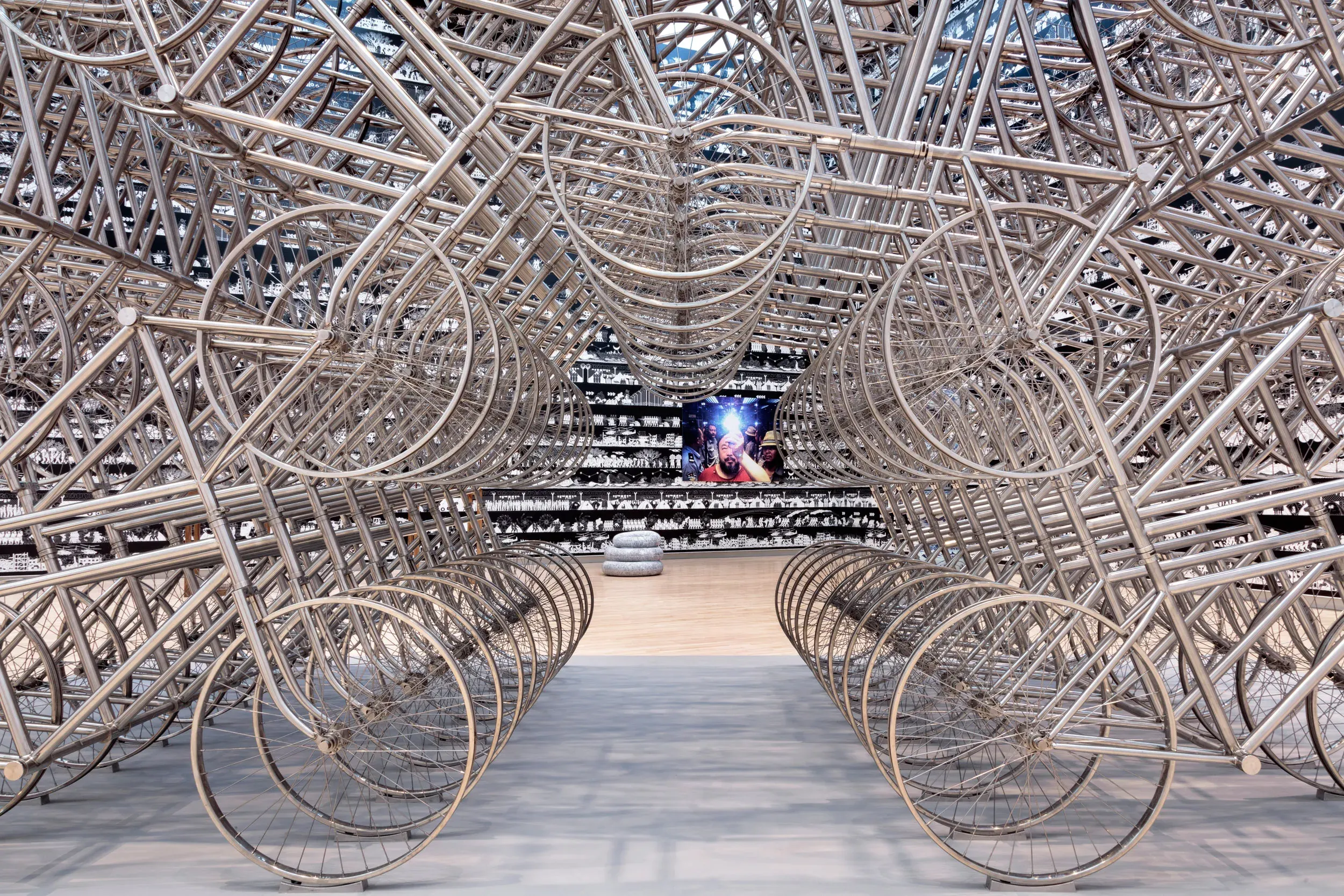
Ai Weiwei’s methodology often involves the deployment of recontextualised commonplace objects. His enduring fascination with bicycles, particularly the ‘Forever’ brand, a common sight in urban China, transforms thousands of them into intricate, labyrinthine geometric sculptures like Forever Bicycles. These are not just dazzling constructions, they are meditations on rapid modernisation, obsolescence, and the endless, collective momentum of an urban society caught between past tradition and future velocity. He takes the ubiquitous, the overlooked, and the historically burdened, the stool, the vase, the bicycle, the Lego brick, and forces a re-evaluation, using their commonality to smuggle complex, dissident ideas into the public consciousness.
His work today continues to interrogate the digital domain, recognising the internet as the ultimate contemporary ‘readymade’ medium, both a platform for freedom and a new frontier for surveillance. Ai Weiwei is less a purveyor of beautiful objects and more an aesthetic provocateur, his art a persistent, necessary grit in the smooth machinery of authoritarianism and indifference. He has achieved a rare synthesis where the man, his biography, his politics, and his output are indivisible, creating a legacy where art is both an eloquent form of witness and a defiant engine of moral accountability, a perennial challenge to the powerful.