NVIDIA Is No Longer Just a Chip Company,
It Is Becoming the Infrastructure Behind the AI World
By Michelle Clark

Nvidia was once known primarily as the company behind the graphics cards that powered gaming PCs, professional visualisation and high performance computing. Today, that description is no longer enough. Nvidia has become one of the central infrastructure companies of the artificial intelligence era, and its importance is no longer measured only by how fast a graphics card can render a game or process a video. Its real importance comes from the fact that modern AI requires enormous amounts of computing power, and Nvidia has built an ecosystem that combines processors, memory, networking, software and complete data centre systems into one increasingly integrated platform. That transformation has made Nvidia one of the most strategically important technology companies in the world, but it has also raised a more uncomfortable question for ordinary computer users: if AI continues consuming more of the world’s computing resources, will powerful computing become increasingly expensive and less accessible?
The scale of Nvidia’s transformation can be seen in its financial results. In its latest reported quarter, Nvidia generated $96.2 billion in total revenue, representing growth of more than 100 percent from a year earlier. Even more striking was its data centre business, which generated approximately $89 billion in revenue, up 117 percent year over year. Nvidia also projected another increase in the following quarter. These numbers demonstrate something much bigger than the success of a particular chip. They show that companies around the world are spending extraordinary amounts of money to build AI infrastructure, and Nvidia has positioned itself at one of the most valuable points in that spending cycle. Nvidia CEO Jensen Huang has described the change in simple terms, saying that “AI has reached its inflection point” and that AI is now doing useful work whose tokens are productive and profitable, adding, “Now, compute is revenue.” The statement captures why Nvidia matters so much. Computing power is no longer merely a tool supporting digital businesses. Increasingly, computing itself is becoming part of the economic engine.
The reason Nvidia has been able to reach this position is not simply because its GPUs are powerful. The deeper advantage is the software ecosystem that developed around them. Nvidia invested heavily in CUDA, its parallel computing platform and programming ecosystem, at a time when much of the technology industry still viewed GPUs primarily as specialised hardware for graphics. CUDA allowed developers and researchers to use Nvidia processors for a much wider range of computational tasks, including scientific computing, machine learning and AI. Over time, researchers, universities, software developers and technology companies built tools and applications around that ecosystem. This created a powerful network effect. A company choosing Nvidia today is not simply buying a processor. It is buying access to an enormous software environment, development tools, libraries, optimisation frameworks and a workforce already familiar with the technology. That makes switching to another platform considerably more complicated than simply replacing one chip with another.
This is one of the reasons Nvidia’s position is sometimes described as a moat. The hardware can be challenged, but the ecosystem is harder to reproduce. AMD, for example, has developed its Instinct family of AI accelerators and its ROCm software ecosystem as an alternative. AMD’s latest data centre GPUs offer very large amounts of high bandwidth memory and substantial memory bandwidth, giving customers a credible alternative for certain workloads. Other companies are developing their own accelerators as well.

Google has its Tensor Processing Units, Amazon has developed Trainium and Inferentia, Microsoft has its own AI accelerator initiatives, and Meta has invested heavily in custom AI silicon. These developments matter because they show that Nvidia’s dominance is not necessarily permanent. At the same time, the enormous scale of Nvidia’s existing ecosystem means that competitors are not merely competing against a chip. They are competing against years of accumulated software, engineering experience, developer adoption and customer familiarity.
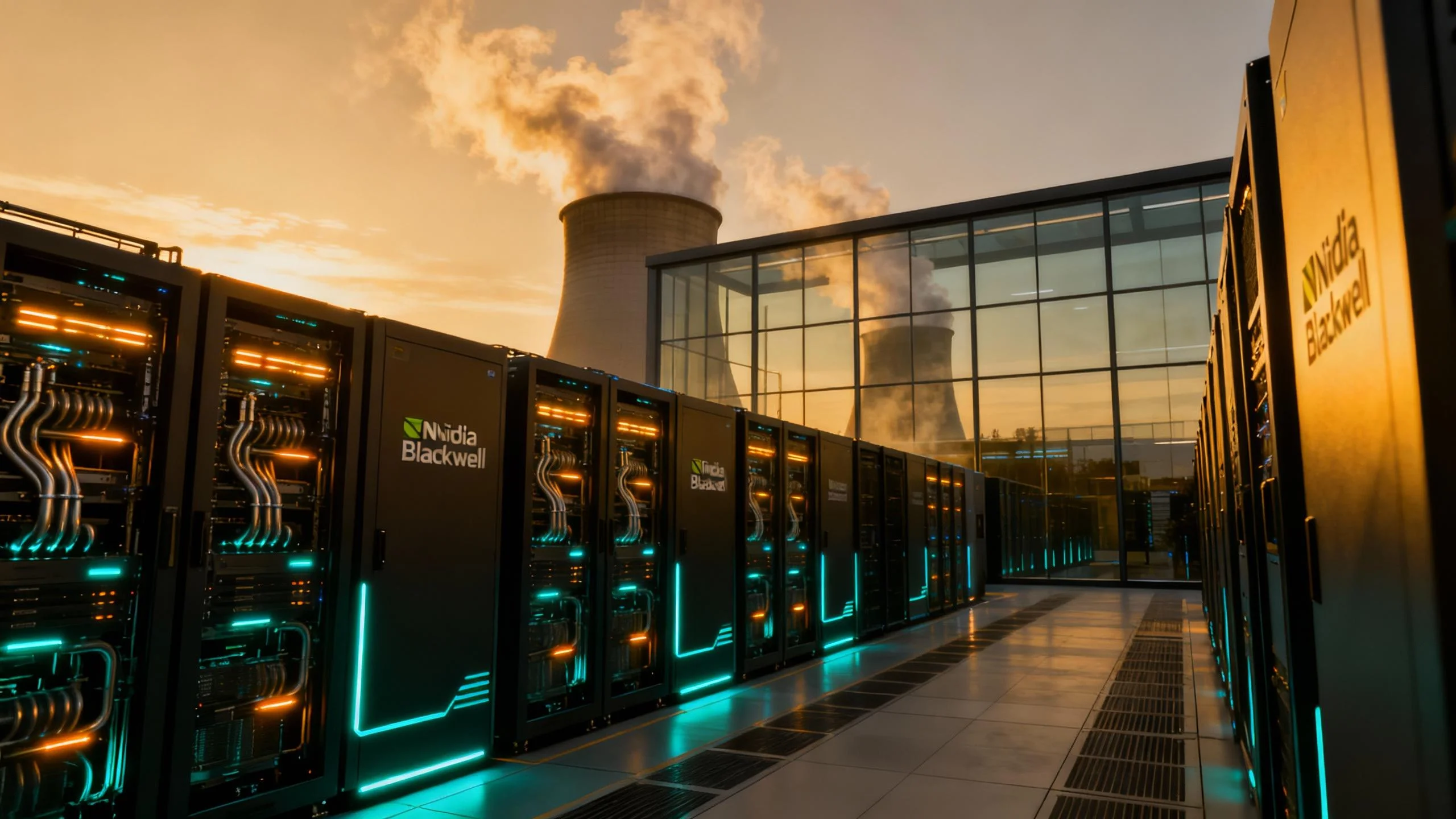
Nvidia’s influence has also expanded because it increasingly sells complete computing systems rather than individual processors. Modern AI data centres require far more than GPUs. They need CPUs, high bandwidth memory, high speed networking, storage, power systems, cooling and software capable of coordinating thousands of processors. Nvidia has moved aggressively into these areas. Its networking technology, interconnects and rack scale systems allow multiple processors to work together as a single computing environment. Its newer platform strategies, including the Vera Rubin generation, demonstrate how the company increasingly sees the data centre as the product rather than the individual chip. That is a fundamental change in the semiconductor business. The company is effectively attempting to control more of the computing architecture surrounding AI, not necessarily by owning every component but by making its components work together as an integrated system.

Google has its Tensor Processing Units, Amazon has developed Trainium and Inferentia, Microsoft has its own AI accelerator initiatives, and Meta has invested heavily in custom AI silicon. These developments matter because they show that Nvidia’s dominance is not necessarily permanent. At the same time, the enormous scale of Nvidia’s existing ecosystem means that competitors are not merely competing against a chip. They are competing against years of accumulated software, engineering experience, developer adoption and customer familiarity.
Nvidia’s influence has also expanded because it increasingly sells complete computing systems rather than individual processors. Modern AI data centres require far more than GPUs. They need CPUs, high bandwidth memory, high speed networking, storage, power systems, cooling and software capable of coordinating thousands of processors. Nvidia has moved aggressively into these areas. Its networking technology, interconnects and rack scale systems allow multiple processors to work together as a single computing environment. Its newer platform strategies, including the Vera Rubin generation, demonstrate how the company increasingly sees the data centre as the product rather than the individual chip. That is a fundamental change in the semiconductor business. The company is effectively attempting to control more of the computing architecture surrounding AI, not necessarily by owning every component but by making its components work together as an integrated system.