The Curator Of Calm
Kate Hutchins
And The Rise Of The “Clean Girl” Economy
By Michelle Clark
In the chaotic, hyper-saturated bazaar of the modern internet, where dopamine-fueled trends cycle faster than a SHEIN delivery, Kate Hutchins stands as a monument to the soothing power of stillness. With over 1.6 million followers on Instagram and a dedicated YouTube community, the Brighton-born, London-based influencer has not merely ridden the wave of the “Clean Girl” aesthetic, she has become its architect. Hutchins represents a specific cultural intersection, the precise point where high street accessibility meets “Old Money” aspiration. She is the digital big sister who teaches a generation of women not just what to buy, but how to construct a life that looks effortlessly put together, even when the reality is anything but. To dismiss Hutchins as just another fashion influencer is to misunderstand the service she provides. In an era of economic uncertainty and fast fashion fatigue, she offers a visual sedative. Her feed is a study in neutrals, oatmeal, camel, charcoal, and crisp white, curated with the rigor of a gallery director.
Kate Hutchins’ primary cultural currency is consistency. While other creators pivot wildly between “Mob Wife Aesthetic” and “Barbiecore” to chase the algorithm, Hutchins has remained steadfast in her commitment to minimalism. This is not an accident, it is a branding strategy rooted in her education at the University of the Arts London. She understands that in a noisy digital environment, visual silence is a luxury. Her style philosophy, often centered on the “capsule wardrobe,” taps into a psychological desire for order.
By advocating for a wardrobe of interchangeable basics like the perfect trench coat, the well tailored trouser, and the oversized blazer, she sells the promise of a friction-free life. If you dress like Kate, the logic goes, you will not only look expensive, but you will also feel organized. This focus on “looking expensive” on a budget is key to her appeal. Unlike influencers who alienate their audience with five-figure hauls, Hutchins built her empire on the “high low” mix. She masters the alchemy of making a £40 sweater from H&M look like a £400 knit from Toteme.
Culturally, this speaks to the “dupe” economy, but Hutchins elevates it. She doesn’t just find cheaper versions of expensive things, she teaches the principles of luxury, regarding fabrication, fit, and silhouette, so her audience can apply them to accessible brands. She has effectively democratized the stylistic codes of the upper class, allowing university students and entry-level employees to opt into an aesthetic formerly reserved for the wealthy.
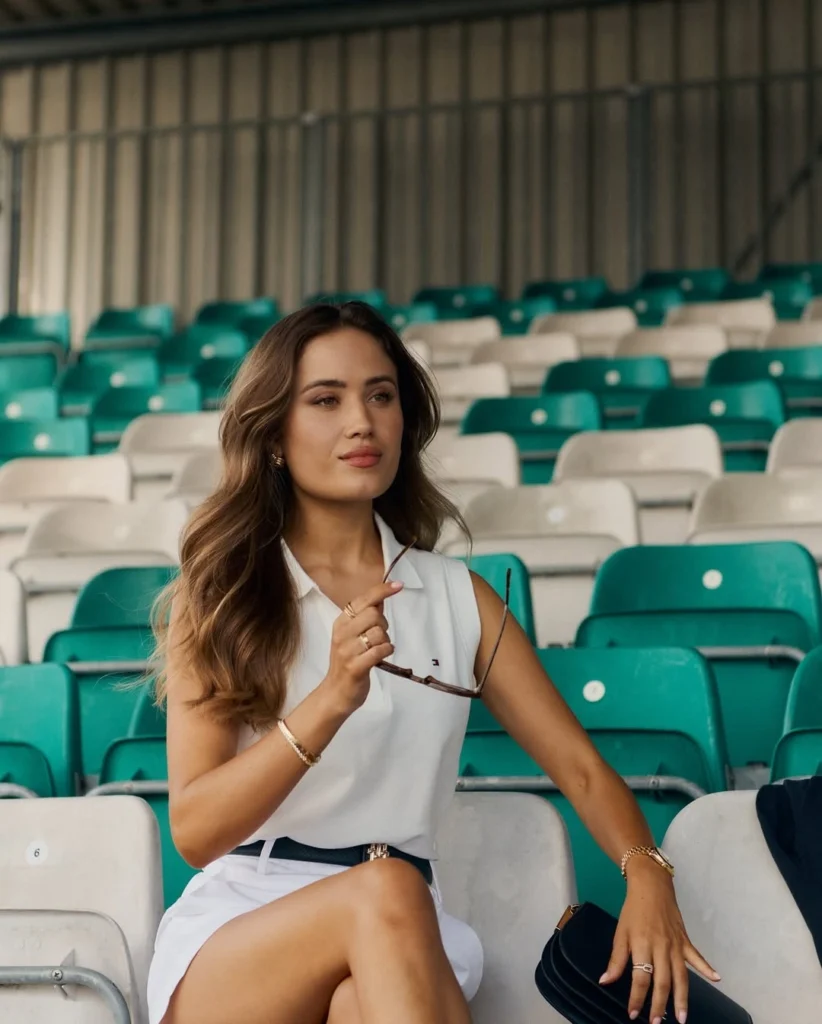
London has always been a fashion capital, but Kate Hutchins packages a very specific slice of the city, specifically the polished, West London sophistication of Chelsea and Kensington. Through her lens, London is not the gritty, avant-garde incubator of Alexander McQueen, but a soft focus backdrop of white stucco houses, brunch spots in Notting Hill, and rainy days spent in beige trench coats. For her international followers, Hutchins is the London lifestyle

She exports a romanticized vision of Britishness that is palatable and aspirational. This has made her a prime partner for brands that rely on British heritage as a selling point. Her collaboration with Holland Cooper, a brand deeply rooted in equestrian and country aesthetics, bridged the gap between the town and country. By wearing Holland Cooper in the city, she translated the “horse girl” aesthetic into something urban and chic, validating the “countryside cosplay” trend that swept through urban centers in the mid 2020s.
Similarly, her partnership with DeMellier to create the “New York Midi” bag solidified her status as a tastemaker who moves product. The bag was not just an accessory, it was a badge of membership for her community, a tangible piece of the Hutchins universe that signaled a shared value of understated elegance. The paradox of the modern influencer is the requirement to be simultaneously perfect and relatable.
A purely curated feed feels cold and corporate, while a purely chaotic one lacks authority. Hutchins navigates this tightrope with a strategic deployment of vulnerability. While her Instagram grid remains a pristine catalogue of outfits, her YouTube channel and Instagram Stories serve as the “backstage” where the parasocial relationship is cemented. Here, the “polished” Kate reveals the cracks in the armor. Her content trajectory, from university vlogs to moving in with a partner, and more recently, navigating heartbreak and new beginnings, mirrors the life stages of her core audience.
The “Heartbreak & New Beginnings” arc in 2025 was a pivotal cultural moment for her brand. In an ecosystem where relationships are often paraded as accessories, her candid discussion of loss and transition deepened her connection with followers. It transformed her from a mannequin into a mentor. By sharing the process of rebuilding her life and her living space post-breakup, she pivoted her content from purely fashion to holistic lifestyle design. She tapped into the “post-breakup glow up” narrative, empowering her audience to find solace in self-care and routine during their own personal upheavals.
Hutchins’ success highlights a shift in advertising where she does not “shill” products but rather “recommends” favorites. This semantic shift is crucial. When she promotes a skincare product from Bare Minerals or a watch from TAG Heuer, it is framed within the context of her actual daily routine. This authenticity, or the successful performance of it, is why her engagement rates remain high despite the saturation of the market. Her audience trusts her to vet the overwhelming market of goods on their behalf. In this sense, she acts as a cultural filter.
The “Kate Hutchins Effect” is real, meaning items she links often sell out not because they are trendy, but because they have been “verified” by her taste. She has turned her personal preference into a trusted quality assurance stamp. However, a cultural analysis of Hutchins must also address the contradictions inherent in her niche. While she champions “capsule wardrobes” and “investment pieces,” her business model relies on the constant promotion of new items. The “neutral aesthetic” can sometimes mask hyper consumption, as buying fifty beige items is still overconsumption, even if it looks minimalist on a rack.
Hutchins attempts to mitigate this by focusing on “ways to wear” videos, showing how to style one item multiple ways, which promotes longevity. Yet, she exists within a capitalist framework that demands novelty. Her skill lies in balancing these opposing forces, convincing her audience that buying this one new blazer is the key to unlocking the potential of their existing wardrobe. It is a comforting fiction that keeps the wheels of the fashion industry turning. Kate Hutchins is more than a girl with a good outfit, she is a mirror reflecting the desires of the 2020s woman.
In a world defined by noise, political instability, and economic precarity, she offers control. She sells the idea that if you can just get your blazer tailored, your skincare routine optimized, and your home décor neutral enough, you can weather the storm. She has professionalized the role of the “It Girl,” stripping away the exclusivity of the past and replacing it with a tutorialized, shoppable roadmap. As she evolves from a fashion blogger into a lifestyle matriarch, entering a new era of independence and self-discovery, she brings her audience along for the ride. Kate Hutchins didn’t just teach the internet how to dress, she taught it that composure is something you can curate, one beige trench coat at a time.