Eric Gagnon
The Birth of the Musical Mushroom & the Mysterious Synchronizations
By Alhanouf Mohammed Alrowaili

In a world breakneck speed, where the accelerators of daily life and intense exposure to electromagnetic fields engulf us, the electrical energy of our internal bodies is severely affected and loses its natural balance. This constant energy disruption has led to the emergence of global health problems such as stress, anxiety, depression, and overstimulation of the nervous system, which in turn transform into vague physical ailments for which conventional medicine sometimes struggles to find radical solutions.
People moved into another way its natural and old its called biohacking or holistic medicine. Within this therapeutic realm, a term recently associated with healing vibrations was born: the “Musical Mushroom.” This innovative small device is designed as an alternative to the traditional wooden mallet. It works with plates and bowls made of stones and crystals, combining sound vibrations with the energy of gemstones, such as clear quartz, to achieve deep relaxation, reduce stress, and promote restful sleep.
This innovation is based on recent research confirming that the body’s cells operate at specific frequencies and vibrations generated by precise bioelectrical processes. These processes interact positively with external vibrations, gemstones, and the nine frequencies of solfège music to restore the body’s balance and stimulate self-healing.
But how does it work? Before delving into the details, we must distinguish between “bio- mushroom music”, a well-known artistic process in which the bioelectric activity of natural mushrooms is converted into musical pieces via electrodes and sensors, and what we are discussing here: the technological device that generates vibrations from crystal bowls, also known as the “musical mushroom.” The designer who created it is an engineer who handcraft it in his hometown in Canada Eric Gagnon.
Eric was born and raised in a small town on Canada’s east coast, of Acadian descent. He won first prize in engineering at the Canadian Science Fair in his senior year of high school and received a scholarship to the electrical engineering program at the University of Ottawa as well as an award to sponsor a future job internship at a company of his choosing. For the next thirty years, Eric worked as an engineer in several startups and aerospace companies, designing and building products that were sold worldwide.
1. Can you explain the mechanical “secret” of how the device interacts with the crystal to produce sound?

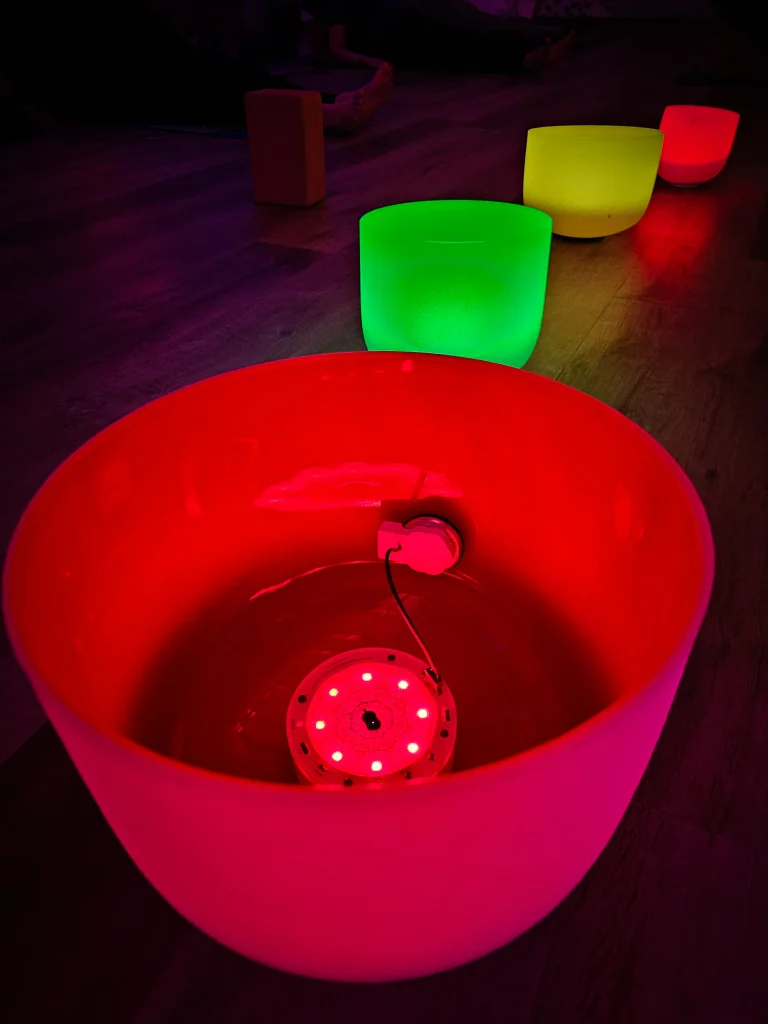
A small “exciter,” simply a vibrating speaker without the paper cone, is attached to the side wall of the crystal bowl. This is first done by attaching a small, screwed plastic mounting disc with double-sided tape. This mounting disc can remain permanently on the bowl or be removed if desired, and you can still use a traditional mallet on the bowls even with the disc in place. When you’re ready to play with the “Musical Mushroom,” the exciter is screwed in and can be removed later when traveling, allowing you to nest the bowls together.
This electromechanical component (the exciter) creates mechanical vibrations under electronic control, causing the bowl itself to vibrate. This is a very important point: the crystal singing bowl itself produces the sound, not the exciter. This is not a recording of the bowl’s sound; it’s the bowl itself vibrating. Instead of stimulating the bowl through friction (like a mallet), the exciter moves the bowl directly at its own resonant frequency through subtle oscillatory movements of its small mass. The bowl does the acoustic work; the exciter is simply the trigger. The control unit sits inside the bowl and uses light pulses to measure the position of the hand above it to adjust the amplitude of those vibrations in real time.
2. What specific materials are used in the device to ensure vibration purity?
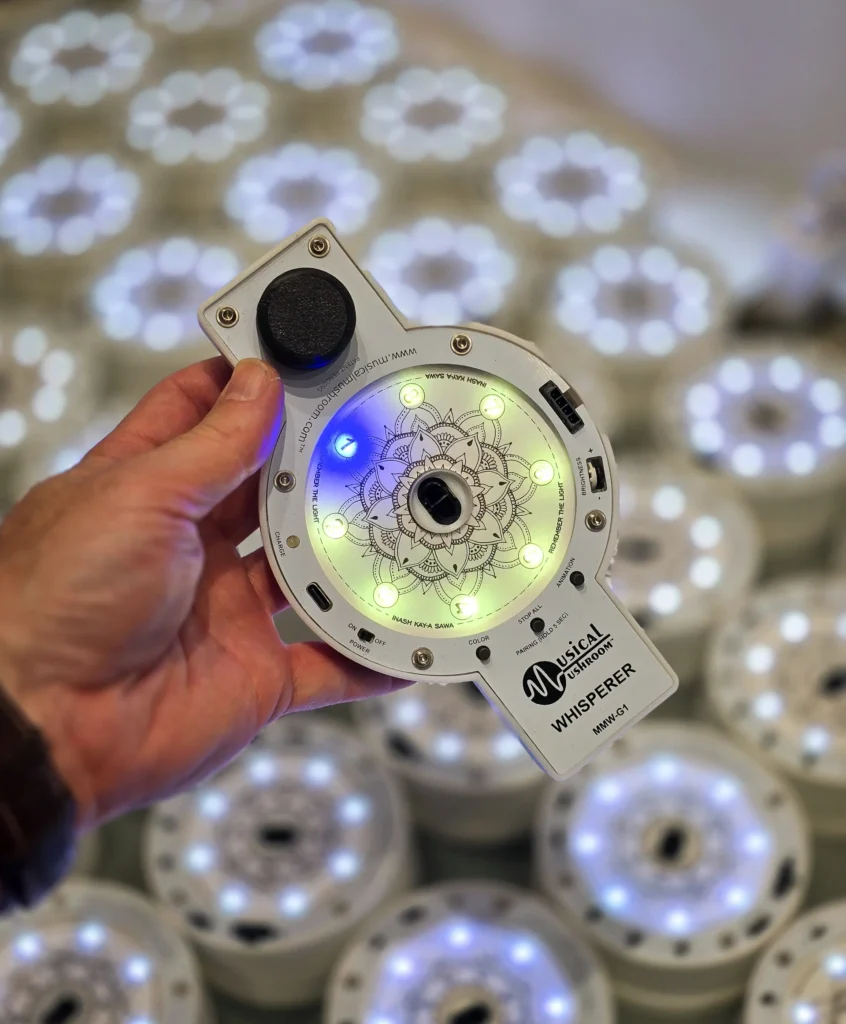
The body and lid of the “Musical Mushroom” are made of 3D-printed plastic, as are the exciter body and mounting discs. This material is extremely lightweight, which is important because the light weight of the exciter alone can dampen thin-walled bowls, so reducing mass was a design priority at every stage. Additional materials include a polycarbonate window and lens.
3. How does the device change the acoustic properties of a traditional singing bowl compared to a hand-operated one?
When the bowl is electronically operated, it resonates continuously with a very pure tone, something a traditional mallet cannot achieve. The device doesn’t alter the bowl’s fundamental frequencies, but it stabilizes how those frequencies are stimulated. The result is a more sustained pure tone and fewer interruptions. Practitioners also note that the device maintains the bowl’s resonance without the frictional sound (often referred to as a rubbing sound) produced by mallets, which is a significant acoustic improvement.
4. Does the type of crystal used significantly alter the frequency or healing properties of the sound?
The resulting frequency is always the bowl’s own natural resonant frequency. The “Musical Mushroom” stimulates whatever frequency the bowl naturally tends to sing at. On the first pass you use the device in a new bowl, a one-time calibration is performed so that it learns the frequency at which that bowl resonates precisely. If you use the same device in the same bowl, it retains those calibration settings. So, yes, the bowl’s construction and geometry determine the frequency; the device simply learns and locks into that frequency. It’s worth noting that the “Musical Mushroom” is sold as an electronic musical instrument and makes no claim to cure, treat, or alleviate any health condition.
5. How do you ensure the device doesn’t dampen the bowl’s natural resonance?
By minimizing the contact area, reducing the weight of the exciter, and strategically distributing it across the bowl. The design aims to stimulate the bowl without absorbing its energy; otherwise, it would stop singing. When powered by the device, damping isn’t an issue because the “Mushroom” actively stimulates the bowl using battery power.
6. Can the “Musical Mushroom” be tuned, or is its output entirely determined by the accompanying bowl?
The device locks into the bowl’s resonant frequency through a one-time calibration. The pitch is determined by the bowl itself; the device affects how well that pitch is maintained, not what it is. However, I have two interesting stories. First, singing bowl manufacturers can’t always predict the exact pitch of their bowls due to numerous variables. One of my clients had a bowl that was close but not perfect pitch. Because it was close enough, she was able to manually calibrate the “Musical Mushroom” to play her bowl at the exact perfect pitch frequency and make it resonate as a perfect pitch bowl! The second story is that any singing bowl vibrates at a few different frequencies called the fundamental frequency and overtones. When using a traditional mallet, you can only stimulate a combination of these frequencies, with the fundamental frequency being the loudest. The “Musical Mushroom,” however, finds the first four resonant frequencies and allows you to select each one individually via the control menu, stimulating the bowl with a single, very pure frequency instead of a combination, something a mallet can’t do. Two Musical Mushrooms can also be connected to a single bowl to independently control the fundamental and overtone frequencies simultaneously, producing two independent tones from one bowl! Two bowls for the price of one.
7. Have you noticed a difference in how your body responds to the sound produced by your device compared to traditional methods?
Sound practitioner Sonia Stingo describes placing her “Musical Mushroom” devices under the table during one-on-one sessions so clients can simultaneously feel and hear the vibrations, noting that this adds a powerful somatic dimension and deepens the therapeutic effect. Lauren Bartfai specifically highlights that the device can maintain a consistent bowl resonance without the sound of mallets rubbing, something she considers truly revolutionary for client immersion.
8. From your perspective, what is the relationship between instrument geometry and the “sacredness” of sound?
Geometry directly affects vibration; the shape and size of the singing bowl determine its sonic characteristics. In the Musical Mushroom, I paid close attention to detail, as seen, for example, in the mandala design on the top surface of the instrument, which was hand-drawn by my yoga instructor. When I considered digitally refining the design to make it perfectly symmetrical and flawless, I decided instead to retain all its human imperfections, recognizing that this is a metaphor for life itself: things may appear perfect from afar, but up close, you see the struggles and flaws. For me, “sanctity” comes not from geometric perfection but from the genuine human intention inherent in the object.
9. Are there specific frequencies that the Musical Mushroom is exceptionally good at sustaining?
It doesn’t inherently favor specific frequencies; rather, it works best with bowls that already possess strong, stable resonant modes. The device is designed to stimulate and sustain whatever frequency the bowl naturally sings at. It works with standard crystal singing bowls, whether frosted, clear, or colored. It is not recommended for metal bowls or gongs due to their irregular surfaces and more complex harmonics.
10. What specific grade of material was chosen for the body to ensure it doesn’t generate unwanted mechanical noise? And how is it installed?
The body of the device is 3D-printed from plastic and rests on a circular silicone ring to prevent mechanical vibrations from being transmitted to the bowl. The device doesn’t contain an internal crystal; it works with the crystal singing bowls themselves. The exciter is screwed onto a plastic mounting disc that is adhered to the inner wall of the bowl with special double-sided tape. The disc is held firmly in place by hand and can be completely removed without damaging the bowl. This threaded connection ensures the exciter remains securely attached to the bowl wall during vibration without rattling.
11. What material is used at the contact point to create the friction necessary for the bowl to sing?
This question mirrors how a traditional mallet works by friction against the rim. The “Musical Mushroom” works on a completely different principle: it uses electromechanical vibrations from the exciter to vibrate the bowl at its resonant frequencies, completely replacing the mallet. There is no frictional contact point; the exciter transmits the vibration directly through its mechanical coupling to the bowl wall, it pushes and pulls the surface at the correct frequency, making the entire bowl resonate.