Eric Gagnon
The Birth of the Musical Mushroom and the Mysterious Synchronizations
By Alhanouf Mohammed Alrowaili
In a world accelerating at breakneck speed, where the accelerators of daily life and intense exposure to electromagnetic fields engulf us, the electrical energy of our internal bodies is severely affected and loses its natural balance. This constant energy disruption has led to the emergence of global health problems such as stress, anxiety, depression, and overstimulation of the nervous system, which in turn transform into vague physical ailments for which conventional medicine sometimes struggles to find radical solutions.
From this point, many have embarked on a profound and different quest to return to their natural state, through the gateways of alternative and complementary medicine; such as sound therapy, frequencies, vibrations, and cleansing the body’s cells and memory of radiation toxins, to restore the chemical and electrical balance that the body naturally releases. At the heart of this world, an exceptional story emerged of transforming a traditional historical healing tool into a smart device serving modern sound therapists, while fully preserving the authenticity and purity of natural sound.
Within this therapeutic realm, a term recently associated with healing vibrations was born: the “Musical Mushroom.” This innovative small device is designed as an alternative to the traditional wooden mallet. It works with plates and bowls made of stones and crystals, combining sound vibrations with the energy of gemstones, such as clear quartz, to achieve deep relaxation, reduce stress, and promote restful sleep. This innovation is based on recent research confirming that the body’s cells operate at specific frequencies and vibrations generated by precise bioelectrical processes. These processes interact positively with external vibrations, gemstones, and the nine frequencies of solfège music to restore the body’s balance and stimulate self-healing.
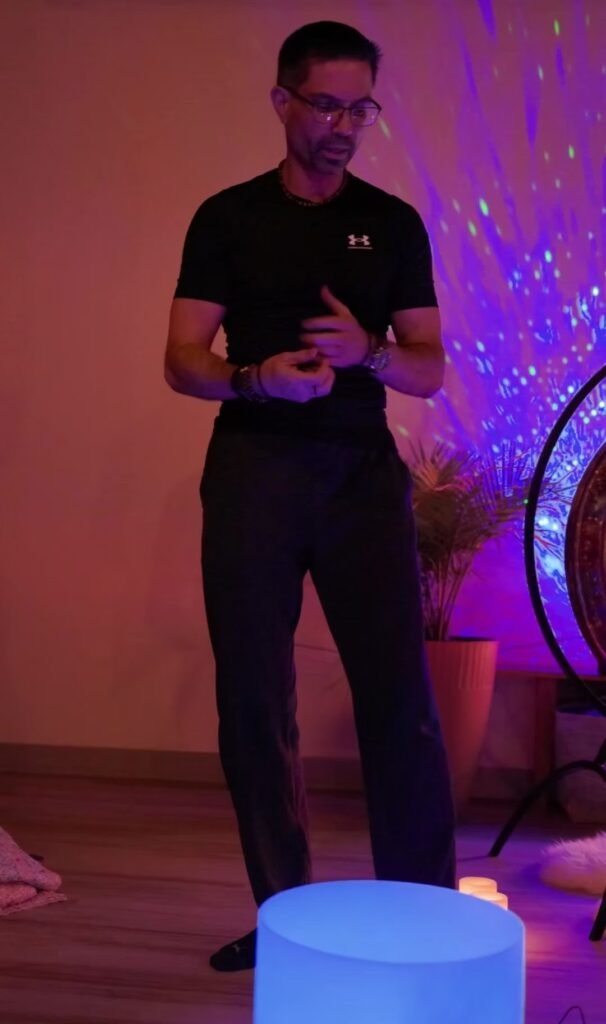
But how does it work? Before delving into the details, we must distinguish between “bio-mushroom music”, a well-known artistic process in which the bioelectric activity of natural mushrooms is converted into musical pieces via electrodes and sensors, and what we are discussing here: the technological device that generates vibrations from crystal plates, also known as the “musical mushroom.” let’s first meet its designer, engineer Eric, who handcrafts it in Canada.
From aviation and Space Equations to the Essence of Spirituality
When the scientific passion and applied research of an engineer and scientist who dedicated his life to exploration and self-learning are channeled into a small device, the result is astonishing. Eric was born and raised in a small town on Canada’s east coast, surrounded by nature and the sea, which shaped his identity and his love of scientific exploration.
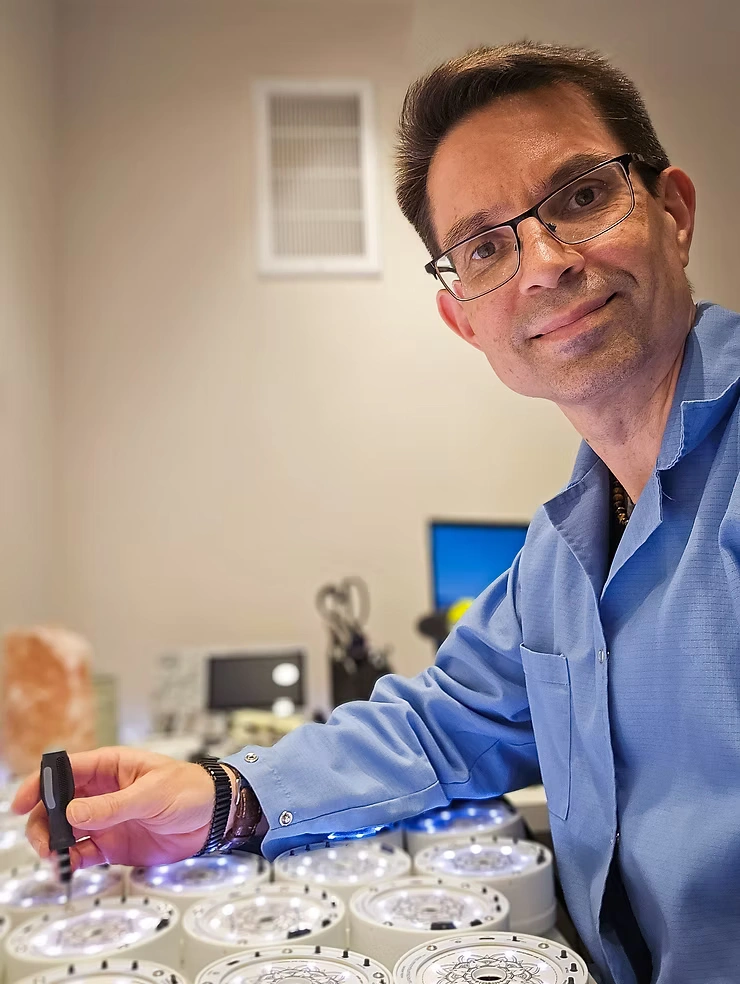
Of Acadian descent, he was the eldest of two sons. His father was a physics and science teacher at the local high school, while his mother was an elementary school teacher who taught him to read and write at a young age. Despite being raised in a religious family, spirituality didn’t deeply touch him until later in life, following his spiritual awakenings. Instead, he spent his early life with a logical mindset, driven by a scientific passion that explained everything based on equations and precise data.
Eric was always fascinated by science, thanks to his frequent trips with his father to the school laboratories, where he enjoyed playing with Tesla coils, Van de Graaff generators, oscilloscopes, and lasers. He was particularly drawn to electricity and electronics, spending his teenage years building electronic projects and participating in science fairs. He won first prize in engineering at the Canadian Science Fair in his senior year of high school and received a scholarship to the electrical engineering program at the University of Ottawa as well as an award to sponsor a future job internship at a company of his choosing. Little did he know then that this was his first experience with synchronicity and unexpected phenomena.
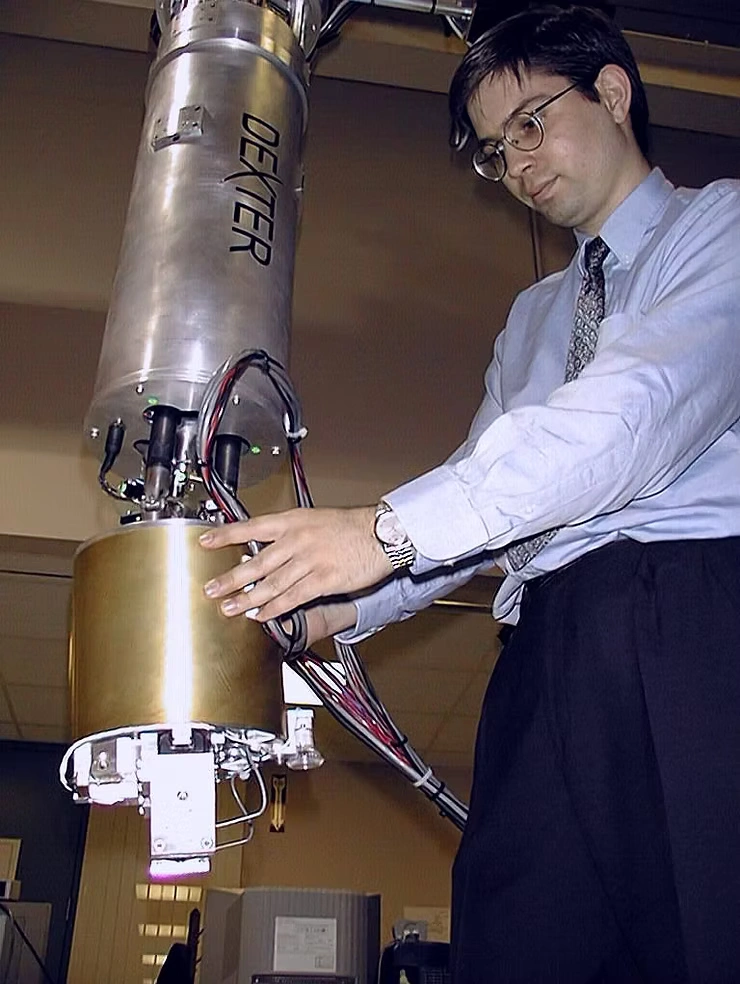
Two years earlier, Eric had watched a documentary about a Canadian aerospace company responsible for designing the robotic arm for the space shuttle. The film showed engineers conducting advanced robotic experiments in a research lab, and immediately, a spark ignited within Eric. He told himself with unwavering conviction, “I really want to work there.” After receiving the award and returning home from the science fair, he decided to waste no time. He used his father’s first-generation IBM PC and dot-matrix printer to write cover letters and mail them, along with his resume, to potential employers, brimming with hopes for the future.
The timing was perfect; The science fair received media coverage in a national newspaper, and a photo of Eric with his hand-built robot was featured in the technology section. Years later, the hiring manager at the aerospace company told him the story: The manager was sitting with a huge pile of resumes in front of him, and during his lunch break, he decided to read his old newspaper. To his astonishment, he saw Eric’s photo and name in the technology section. He read the article with great interest, and when he put the newspaper down and picked up the next resume in the pile, he realized, to his amazement, that it was Eric’s own!
Eric was immediately invited for an interview, received a job offer, and ended up working in the same robotics lab alongside the very same engineers he had seen in the documentary years earlier, 1,500 kilometers away!
The Breaking Point… and a New Beginning
For the next thirty years, Eric worked as an engineer in several startups and aerospace companies, designing and building products that were sold worldwide. He dedicated tremendous effort and long hours to facing increasing challenges, until one day everything collapsed, and his life changed forever. At the age of 46, while working for an early-stage, underfunded and understaffed startup aerospace company, Eric fell into the trap of multitasking without setting personal boundaries.
His health deteriorated, exercise and balance disappeared from his life, and alarming physical symptoms began to appear. These were clear signals from his body that he had ignored for years, and repeated doctor visits and emergency room appointments yielded no explanation other than “burnout,” a diagnosis he didn’t want to believe. Eventually, it escalated into severe depression and extreme exhaustion, coinciding with a midlife crisis and despair. He was broken, suffering in silence, and feeling so helpless that he wished he could end it all.
At his lowest point, he decided to seek help after reading an inspiring article by a man who had gone through similar circumstances and recovered not by finding a single solution, but by applying five different things. Eric changed jobs and spent the next year exploring uncharted territories; he began reading about spirituality and religion, listened to spiritual guides, and devoured hundreds of books on self-help and brain science. He visited a therapist, a naturopath, and a Reiki practitioner, and joined a yoga studio that played a pivotal role in his healing and in forging strong friendships. He practiced walking, breathing exercises, cold exposure, acupuncture, and learning to play the ukulele and guitar. He also attended sound meditation sessions, tarot readings, and past-life recollections. He realized then that his past life had been one-dimensional, and that the universe was far more expansive than he had imagined, and the characteristics of the right hemisphere of his brain began to balance with his more logical left hemisphere.
The Birth of the Musical Mushroom and the Mysterious Synchronizations
One day, while lying on the floor during his twentieth group sound meditation session, sound therapist Margo was playing on singing bowls scattered around the room. The vibrations of each bowl faded rapidly as she moved away from it. At that moment, the idea of the “musical mushroom” was born, like a seed planted in his mind. He considered the possibility of making the bowls vibrate electronically and controlling them remotely.
This time, he felt a strong urge to complete the idea, not for financial gain, but as someone entrusted with a mission to raise global awareness. He began working on prototypes, and after several unsuccessful attempts, he developed a simple prototype with a long stem and a mushroom-like cap. He showed it to Margo who was impressed.
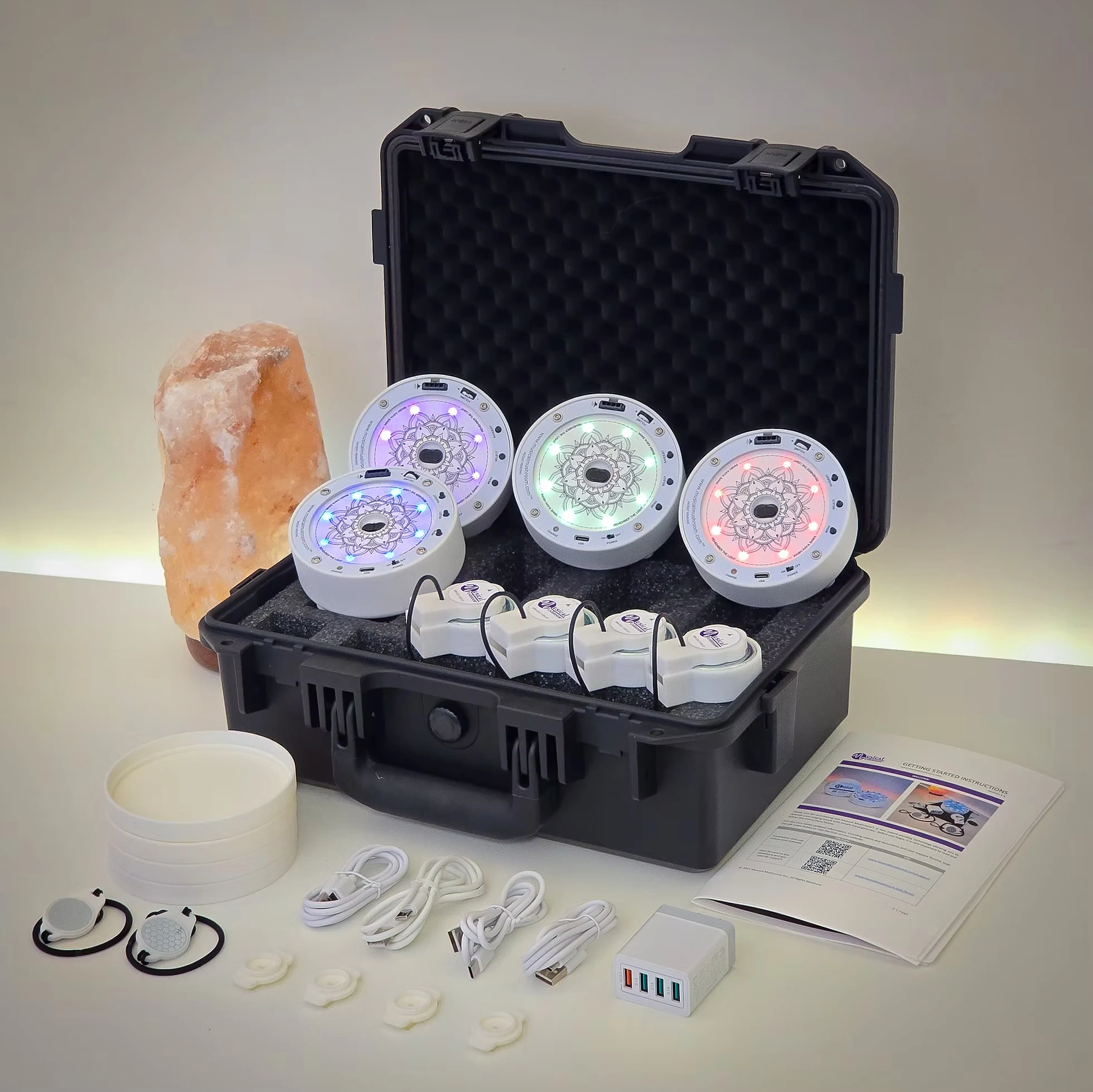
It soon became clear that controlling the device via a phone app wasn’t the ideal solution, as sound therapists prefer direct interaction and a distance from technology during sessions. And then came another inspiration: replacing the smartphone’s interface with a hand gesture sensor (an infrared light) that detects hand position in real time, enabling control of the bowl’s vibrations using natural and intuitive hand gestures for easier multitasking. After filing the patent application, he spent six months traveling between yoga studios to gather user feedback and refine the internal software.
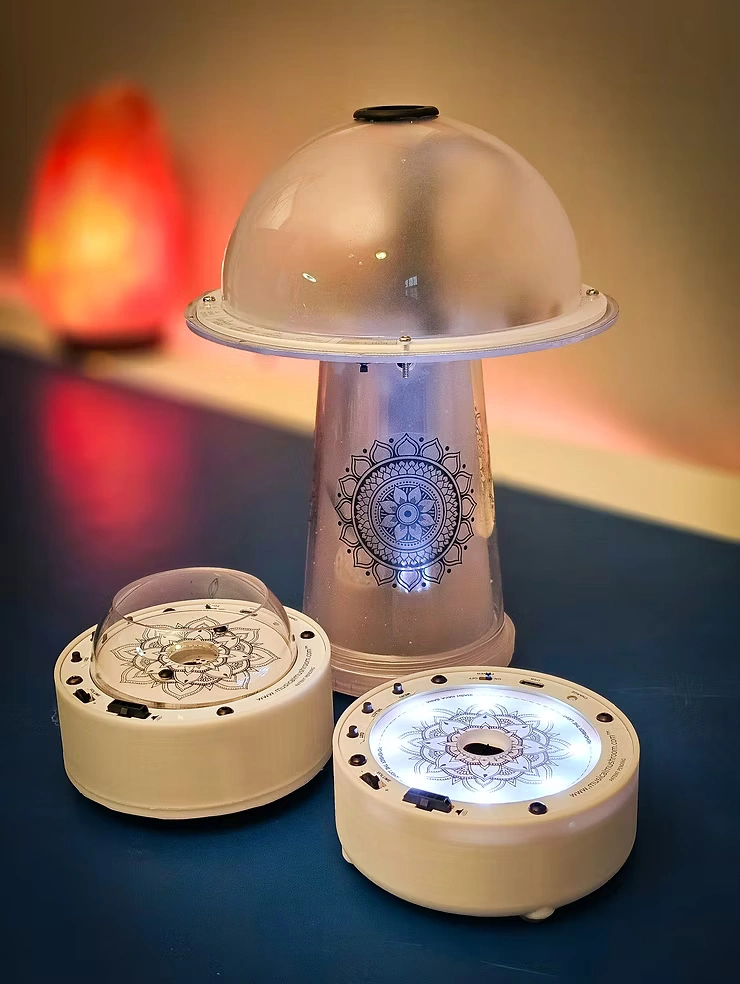
Eric was keen to humanize the product, so he enlisted his friend Claudia, a local yoga studio owner and a talented to draw a hand-drawn mandala design. She completed it in a single, uninterrupted two-hour session without lifting her head. When the design was scaled down to fit the device’s surface, his engineering mindset caught some minor imperfections. He considered digitally adjusting it for perfect symmetry, but he abandoned the idea, realizing that these flaws reflected everyday life, which appears perfect from afar but is full of details and struggles up close. In a remarkable coincidence, the spontaneously drawn mandala contained eight dots, and when placed on a circuit board equipped with eight LEDs, the dots aligned with the lights with perfect precision and without any prior planning! The coincidences didn’t stop there. He wanted to incorporate a mantra around the mandala and recalled the phrase “Inash Kaya Sawa,” which a woman in a trance had uttered during a flashback session the previous night. The phrase means “Remember the light.” A shiver ran through him when he contacted the woman and asked her permission, only to discover that she frequented the same yoga studio, neither of them aware of working with the same past life regressionist!
The Musical mushroom is designed for indoor use. It should not be exposed to rain, high humidity or severe weather conditions like extreme heat or cold.
Extending into the Future and the “Whisperer” Device
For the past two years, Eric has meticulously assembled each unit by hand as a passion project in his spare time, shipping them worldwide to widespread acclaim. His thoughts and reflections recently culminated in a revolutionary addition to the product line: the “Whisperer” remote control.
The “Whisperer” device is a central wireless control unit that allows the therapist to control up to eight “Musical Mushrooms” distributed throughout the therapy room from a single, comfortable location. It also supports the MIDI protocol via a USB cable, enabling computer control using Digital Audio Workstation (DAW) software for those who prefer this method of playing. This innovation freed therapists from the physical congestion and the need to move between individuals lying on the floor, fulfilling the original vision Eric had while reclining in a sound session three years prior.
He filmed all the instructions needed in his website www.musicalmushroom.com with all needed information of his invention to help the users with no experience to use it in group sessions or alone at home to self-healing journey.
1. Can you explain the mechanical “secret” of how the device interacts with the crystal to produce sound?
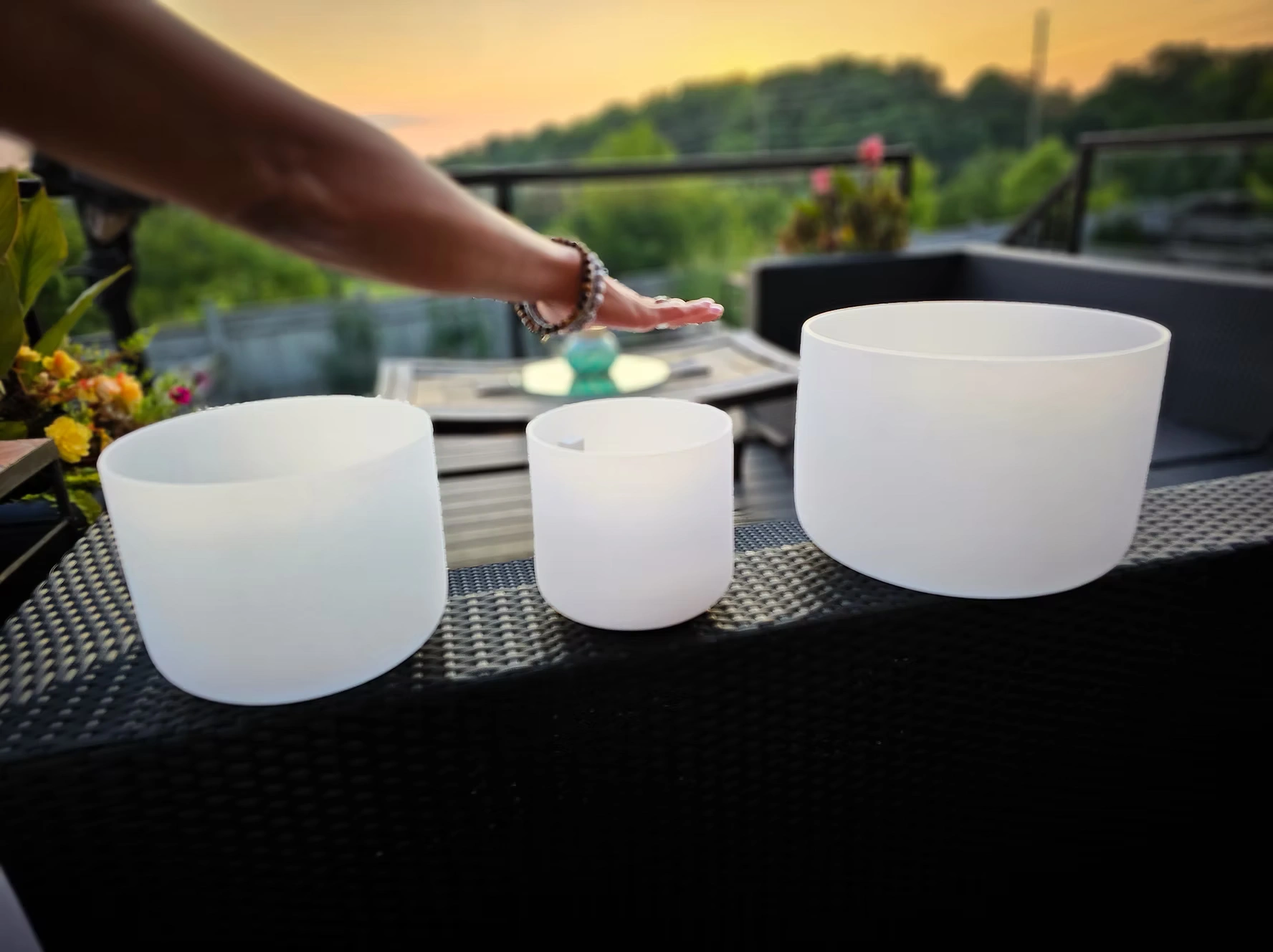
A small “exciter,” simply a vibrating speaker without the paper cone, is attached to the side wall of the crystal bowl. This is first done by attaching a small, screwed plastic mounting disc with double-sided tape. This mounting disc can remain permanently on the bowl or be removed if desired, and you can still use a traditional mallet on the bowls even with the disc in place. When you’re ready to play with the “Musical Mushroom,” the exciter is screwed in and can be removed later when traveling, allowing you to nest the bowls together.
This electromechanical component (the exciter) creates mechanical vibrations under electronic control, causing the bowl itself to vibrate. This is a very important point: the crystal singing bowl itself produces the sound, not the exciter. This is not a recording of the bowl’s sound; it’s the bowl itself vibrating. Instead of stimulating the bowl through friction (like a mallet), the exciter moves the bowl directly at its own resonant frequency through subtle oscillatory movements of its small mass. The bowl does the acoustic work; the exciter is simply the trigger. The control unit sits inside the bowl and uses light pulses to measure the position of the hand above it to adjust the amplitude of those vibrations in real time.
2. How many prototypes did you go through before arriving at the current “mushroom” shape?
There were three major design updates (and countless minor tweaks in between). The first prototype; it was relatively tall and shaped like a mushroom, hence the original name! After showing it to sound therapists, they pointed out that this large shape wasn’t ideal for transportation. It was bulky and unstable and could tip over and fall into the bowl, potentially damaging it. I then moved on to the second prototype and tried to maintain the essence of the “mushroom.” However, the dome was very complex and expensive to manufacture, as were the internal components, and it wasn’t exactly suitable for transport. The dome has been eliminated, the height reduced, and a flat lid designed to allow the devices to be stacked on top of each other during transport, making it very practical and travel friendly. Although the final shape no longer resembles a mushroom, the name “Musical Mushroom” has stuck!
3. What specific materials are used in the device to ensure vibration purity?
The body and lid of the “Musical Mushroom” are made of 3D-printed plastic, as are the exciter body and mounting discs. This material is extremely lightweight, which is important because the light weight of the exciter alone can dampen thin-walled bowls, so reducing mass was a design priority at every stage. Additional materials include a polycarbonate window and lens.
4. How does the device change the acoustic properties of a traditional singing bowl compared to a hand-operated one?
When the bowl is electronically operated, it resonates continuously with a very pure tone, something a traditional mallet cannot achieve. The device doesn’t alter the bowl’s fundamental frequencies, but it stabilizes how those frequencies are stimulated. The result is a more sustained pure tone and fewer interruptions. Practitioners also note that the device maintains the bowl’s resonance without the frictional sound (often referred to as a rubbing sound) produced by mallets, which is a significant acoustic improvement.
5. Does the type of crystal used significantly alter the frequency or healing properties of the sound?
The resulting frequency is always the bowl’s own natural resonant frequency. The “Musical Mushroom” stimulates whatever frequency the bowl naturally tends to sing at. On the first pass you use the device in a new bowl, a one-time calibration is performed so that it learns the frequency at which that bowl resonates precisely. If you use the same device in the same bowl, it retains those calibration settings. So, yes, the bowl’s construction and geometry determine the frequency; the device simply learns and locks into that frequency. It’s worth noting that the “Musical Mushroom” is sold as an electronic musical instrument and makes no claim to cure, treat, or alleviate any health condition.
6. How do you ensure the device doesn’t dampen the bowl’s natural resonance?
By minimizing the contact area, reducing the weight of the exciter, and strategically distributing it across the bowl. The design aims to stimulate the bowl without absorbing its energy; otherwise, it would stop singing. When powered by the device, damping isn’t an issue because the “Mushroom” actively stimulates the bowl using battery power.
7. Is there a specific “sweet spot” on the instrument that required the most engineering to perfect?
The precise internal position on the wall where the exciter is mounted is where the mechanical energy transfer occurs. Adjusting this coupling to be firm enough to transmit vibrations clearly, yet light enough not to overload the bowl, was a significant challenge. In addition, developing the internal software to be able to automatically detect and control bowl resonant frequencies based on hand gestures took more than a year to develop and improve based on user feedback.
8. Can the “Musical Mushroom” be tuned, or is its output entirely determined by the accompanying bowl?
The device locks into the bowl’s resonant frequency through a one-time calibration. The pitch is determined by the bowl itself; the device affects how well that pitch is maintained, not what it is. However, I have two interesting stories. First, singing bowl manufacturers can’t always predict the exact pitch of their bowls due to numerous variables. One of my clients had a bowl that was close but not perfect pitch. Because it was close enough, she was able to manually calibrate the “Musical Mushroom” to play her bowl at the exact perfect pitch frequency and make it resonate as a perfect pitch bowl! The second story is that any singing bowl vibrates at a few different frequencies called the fundamental frequency and overtones. When using a traditional mallet, you can only stimulate a combination of these frequencies, with the fundamental frequency being the loudest. The “Musical Mushroom,” however, finds the first four resonant frequencies and allows you to select each one individually via the control menu, stimulating the bowl with a single, very pure frequency instead of a combination, something a mallet can’t do. Two Musical Mushrooms can also be connected to a single bowl to independently control the fundamental and overtone frequencies simultaneously, producing two independent tones from one bowl! Two bowls for the price of one.
9. What is the most challenging aspect of manufacturing this instrument?
Each unit receives individual attention rather than being mass-produced. I personally assemble each unit by hand as a passion project in my spare time. I also oversee all manufacturing and shipping logistics. Due to the large number of sub-components that need to be manufactured and assembled, this process requires significant time and effort for assembly, calibration, and testing.
10. Have you noticed a difference in how your body responds to the sound produced by your device compared to traditional methods?
Sound practitioner Sonia Stingo describes placing her “Musical Mushroom” devices under the table during one-on-one sessions so clients can simultaneously feel and hear the vibrations, noting that this adds a powerful somatic dimension and deepens the therapeutic effect. Lauren Bartfai specifically highlights that the device can maintain a consistent bowl resonance without the sound of mallets rubbing, something she considers truly revolutionary for client immersion.
11. What are the most common comments you receive from professional sound therapists who use your device?
They often appreciate its ease of use, consistency, and ability to sustain tones without fatigue. A common theme in all testimonials is freedom, specifically, the freedom to multitask. Marcus Fung describes it as an “acoustic anchor” that frees his hands to focus on other instruments, allowing for richer pitches and smoother transitions. Sonia Stingo says it’s like having a second practitioner playing alongside her. Lauren Bartfai sums it up simply: This technology gives her the freedom to clone herself and play multiple instruments simultaneously.
12. Do you see this as a tool for professional occupational therapy, or is it designed for personal home use?
It suits both. Professionals benefit from the reliability and stability, while beginners benefit from the accessibility and ease of use. I have users all over the world from all walks of life.
13. From your perspective, what is the relationship between instrument geometry and the “sacredness” of sound?
Geometry directly affects vibration; the shape and size of the singing bowl determine its sonic characteristics. In the Musical Mushroom, I paid close attention to detail, as seen, for example, in the mandala design on the top surface of the instrument, which was hand-drawn by my yoga instructor. When I considered digitally refining the design to make it perfectly symmetrical and flawless, I decided instead to retain all its human imperfections, recognizing that this is a metaphor for life itself: things may appear perfect from afar, but up close, you see the struggles and flaws. For me, “sanctity” comes not from geometric perfection but from the genuine human intention inherent in the object.
14. Are there specific frequencies that the Musical Mushroom is exceptionally good at sustaining?
It doesn’t inherently favor specific frequencies; rather, it works best with bowls that already possess strong, stable resonant modes. The device is designed to stimulate and sustain whatever frequency the bowl naturally sings at. It works with standard crystal singing bowls, whether frosted, clear, or colored. It is not recommended for metal bowls or gongs due to their irregular surfaces and more complex harmonics.
15. What is the biggest challenge in explaining a “new” instrument to a traditional musical community?
Skepticism. Musicians often trust established techniques and may see mechanical aids as unnecessary or lacking in authenticity. Change is always difficult, but the one thing I’ve noticed is that most of the “Musical Mushroom’s” skeptics are people who haven’t had firsthand experience with it and are speaking solely based on personal biases. Those who have tried the device have overwhelmingly endorsed its use and recognized its value, and they are leading the next wave of sound therapists.
16. Where do you see the evolution of the “Musical Mushroom” in the next five years?
I am currently working on a list of technical and manufacturing improvements, including new software features that are regularly released free of charge to existing users. I also have several ideas for complementary products that I want to add to the lineup over the next few years, such as the “Whisperer” wireless central control unit I recently introduced, which allows me to control up to eight Mushrooms in a room from a single location.
17. What specific grade of material was chosen for the body to ensure it doesn’t generate unwanted mechanical noise? And how is it installed?
The body of the device is 3D-printed from plastic and rests on a circular silicone ring to prevent mechanical vibrations from being transmitted to the bowl. The device doesn’t contain an internal crystal; it works with the crystal singing bowls themselves. The exciter is screwed onto a plastic mounting disc that is adhered to the inner wall of the bowl with special double-sided tape. The disc is held firmly in place by hand and can be completely removed without damaging the bowl. This threaded connection ensures the exciter remains securely attached to the bowl wall during vibration without rattling.
18. What is the weight distribution in the device, and is there a neutral resonance?
The mounting disc is extremely lightweight, and the exciter is attached to it via plastic screw threads instead of directly impacting the bowl wall. The control unit itself rests simply on a soft silicone o-ring and does not exert any lateral pressure on the walls. The device is engineered to have completely neutral resonance; only the exciter is physically connected to the bowl surface, inputting energy at the bowl’s natural resonant frequency rather than its own.
19. What material is used at the contact point to create the friction necessary for the bowl to sing?
This question mirrors how a traditional mallet works by friction against the rim. The “Musical Mushroom” works on a completely different principle: it uses electromechanical vibrations from the exciter to vibrate the bowl at its resonant frequencies, completely replacing the mallet. There is no frictional contact point; the exciter transmits the vibration directly through its mechanical coupling to the bowl wall, it pushes and pulls the surface at the correct frequency, making the entire bowl resonate.
20. How do you test the device against material fatigue to ensure that the vibrations don’t cause the structure to crack over time?
I spent about six months touring yoga studios and events to gather real-world feedback, which would have revealed any durability issues in practical conditions. I’ve also sold units worldwide over the past two years without any problems. The device also has a knob to adjust the “maximum allowable” volume, which limits the maximum vibration intensity. Because the vibration levels involved are relatively low, and because the exciter stimulates the bowl via a smooth adhesive tape interface without any actual abrasion, structural fatigue is not a major concern in normal use. Compared to using a traditional mallet, the device is much safer, as a mallet can be abused through forceful blows or accidental drops.
21. Is the device a single, solid piece, or is it an assembly of multiple parts?
It is a multi-part assembly. The kit includes: the “Musical Mushroom” controller, a protective cover, the exciter, a protective cover for the exciter, a mounting disc, a charger and USB cable. The controller itself integrates the infrared light gesture sensor, LED ring, battery, and operating electronics into a single 3D-printed housing. The exciter is a separate component that attaches to and detaches from the mounting disc as needed. Each part has a distinct function, and the system is designed for easy field assembly and disassembly.
Today, when Eric looks back, he sees the beautiful irony that his “engineering” side would never have known the spiritual community, and his “spiritual” side would never have possessed the technical knowledge. The convergence of these two worlds is what made the “Musical Mushroom” possible; the first phase of his life provided him with technical skills, while the second gave him purpose and a sense of mission. He looks back on his past and his difficult times with profound gratitude, recognizing that it is through challenging experiences that one’s essence is forged and driven to fulfill their purpose on Earth.